The happiness part was too much: Confession of an Apostate

by FrozenFlame

Yet another morning of waking too early, feeling uprooted, distracted, and in the midst of transforming into something else, my wish and ability to “meditate” utterly gone. That’s what they told me once – that apostates become like bardo beings, as if already in the dreamlike state between one death and the next rebirth. Well, I grimly think. At least for once I’m feeling exactly the way I’m supposed to feel.

Yesterday I did what would have been unthinkable just a week ago. My Centre was already filled with the aroma of hearty soup brewing for one of those “Food for Thought” classes when I walked in, fortunately not encountering anyone, and discreetly dropped off my freshly laundered robes, my pictures of Kelsang Gyatso (KG) and even my NKT t-shirts, then briskly walked out and tapped my phone to send a pre-written email to the New Kadampa Tradition (NKT) letting them know that I was done with them.It all could have been worse, much worse. I am a Millenial who never experienced poverty, sickness nor discrimination. Some bullying at school for being a teacher’s pet and know-it-all, but that was long before cyberbullying and the technological basis for it even existed. Overall I have long felt that my good fortune was undeserved, and dreaded that someone would judge me on that account. If there is someone I admire, I easily imagine them watching me and judging everything I do, and it’s like I will never be able to accept myself until I become exactly like them. My opinions are easily swayed by whatever I get into, and yet once my heart is set on doing something, I get as stubborn as one of Tolkien’s Dwarves. All those are traits that made me vulnerable to KG’s mind-warping books and the kind of pressure one feels in the organization he has created.

I didn’t set out to be a cult survivor, that wasn’t one of my goals in life. This is the story of a man who ended his existence as a “fortunate modern ordained Kadampa disciple” lest he should have eventually ended his existence altogether. There is not much here that hasn’t been said by other survivors before, and my experiences were by no means the worst, nor will I speak to KG’s character, life as a resident in a Centre (which I never was) or the obscure circumstances surrounding the NKT’s foundation; others more qualified than myself have amply done so already. Please consider this to be my humble contribution to building a critical mass of testimonies against this cult. I dedicate it to those who were drawn in at a younger age than I was. Am I then like the founder of the nihilistic Charavaka school, who, according to Chandrakirti, committed many negative actions then wrote an extensive treatise to justify himself and salvage his reputation? Well, I have no reputation left to salvage with the NKT members. As for the “outside” people, most never knew I was a monk to begin with, even my extended family knew it but vaguely. I kept quiet about the matter out of fear, mind you, that my bad example would reflect negatively on the organization. And is it self-justification, considering how the human mind is amazingly good at rationalizing choices that were driven by unconscious motives? If so, that’s my own affair.

The Guru’s Mandala, revisited

The NKT as I understand it consists of four concentric circles, which we’ll look at from the outside in. The further in you are, the harder it is to leave/question the Tradition and its dogmas, not least because is becomes your role to promote them. This model is subjective and imperfect, being a model, but it should be helpful to those (wise) people who didn’t stick around for very long.

The first circle is the General Programme (GP), not including Celebrations/Festivals. Those are the weeknight teachings, the guided meditations, the Branch classes, the Saturday workshops, the open houses, the public talks by guest teachers – whatever a Centre advertises broadly to attract newcomers, as solutions to anger, anxiety, feelings of powerlessness and so forth. KG once said that the most important person in any Centre was the casual student or the potential one who had not yet walked in. Prayers and protocol are kept to a minimum, and some themes are avoided as they would send people running, including parts of the credo – I laugh to think of how someone would react if they heard the “Request to the Lord of All Lineages” on their first visit. If you attend those regularly, you are eventually encouraged to attend a Festival or Celebration, as a “rare and precious opportunity”.

The second circle consists of Celebrations/Festivals, which are technically part of GP but will impress you at a deeper level, especially the first time. The chanting, the decorum, the expansive/expensive offerings, the size of the enthusiastic crowd, are like nothing you’ve seen before, so if you walk in as I did simply expecting a casual Buddhist talk, you’re in for a treat. Welcome to “creating merit” as a synonym for volunteering, to hearing catchphrases from the throne like “our Guru’s Holy Speech”, “unmistaken Dharma”, “our mind appears things”, “how wonderful”, “what could be more meaningful than this” and more repetition of the word “pure/purely” than you’ve ever heard.The most striking contradiction between KG’s books (specifically Joyful Path of Good Fortune and Great Treasury of Merit) and his organization’s own practices pertains to the teaching on relying upon a Spriritual Guide. Choosing someone to guide you on the path to enlightenment is supposed to be a very serious matter, a well thought-out process, and you should first get to know them well enough to be satisfied that they have higher realizations than yourself (at the very least). Furthermore, breaking your commitment to your Spiritual Guide is described as having very severe karmic consequences, such as amounting to forsaking all the Buddhas, being blocked from any further spiritual realizations, exposing yourself to disease and demonic possession, and last but not least, repeated rebirths in hell (Joyful Path 1995, p. 103). If you raise any concerns about that list they are gently laughed off (“what are you so afraid of?”).But my point is, when you enter the second circle, that choice is made for you, because most Festivals/Celebrations feature “empowerments”, which involve committing yourself to KG and entering his Tantric lineage, if only through the ritual closing phrase “I shall do everything the Principal [the teacher, as a representative of KG] has said”. Not to mention that all empowerments also involve taking the Refuge Vows and the Bodhisattva Vow – promising to attain enlightenment for the sake of all living beings, which, to an unprepared mind, amounts to taking the weight of the world on one’s shoulders. After my first empowerment I remember wondering, wait, did I just promise to pray to this scary deity (Dorje Shugden) for the growth of this tradition, and the destruction of its enemies, every day of my life? An even more absurd example is that of a practitioner who recalled how after her first empowerment she had told her friend, “I’m still not sure I’m a Buddhist” and the friend had replied “you just took the Bodhisattva Vow, so now you are!” In short, no later than the second circle, commitments are exacted from you by sheer pressure, much like signing the adhesion contract for a social media platform, where the legal clauses are so long and hard to understand that nobody bothers to read them. One last thing: in a Festival/Celebration, you are certain to get at least one spiel on how the NKT is KG’s heart and the last pure Buddhist lineage in the world, which you must help to “flourish” by serving your Centre. This all tends to make a strong impression on your unconscious, and be more than what you bargained for.

The third circle is the Foundation Programme (FP) and the more intensive Teacher Training Programme (TTP), which do involve a written commitment, including among other things to help your Centre “to the best of your ability”. That in entirely one-sided, but also vague, making it hard to determine how much money and how many hours a week is enough. At this level the all-hands-on-deck spiels become regular occurrences and you are regularly called upon to help distribute publicity. My last resident teacher (RT) would often say as a disclaimer “I know I’m speaking to the TTP students here”, implying that whatever she said was not suitable for newcomers but nonetheless true, i.e. that the NKT could not show its fanatical, expansionist face to people not yet conditioned, lest it should scare the good prospects away. In the classes themselves, the teacher gives a line by line commentary; the paired “discussions” are limited to helping each other remembering what was said, whereas in the group “discussions” two students sit in front and answer the others’ questions while the teacher sits behind them ready to intervene at any time. Often we are reminded beforehand how these group discussions should proceed, including “if we have negative feelings, those are coming from our self-cherishing mind, and therfore we should not blame others”. There is no room for critical questioning, only for interactive indoctrination. Doubts are tolerated only as a phase, something to be overcome on the path to “correct view”.I entered the second and third circles almost simultaneously (within one month), about two years after I had entered the first.

The fourth circle, the one I never entered nor seriously considered entering, is to become a Centre manager, especially an RT. This is where you have the most prestige and responsibility, but not the most power. Arguably, you have even less power over your own life than ever before, because your only currency is reputation for loyalty. I won’t speak through my hat here nor merely repeat what others have said, so please see “Why I no longer study Kadampa Buddhism”, from buddhist-controversy-blog.com.

About the same time I entered my first Centre, I joined a mystical organization, with I’ll simply call [the Order]. One of its leaders insisted in an introductory talk, among other things, that [the Order] was not a religion because it did not seek to convert the masses with dogmas they would have to believe no matter what, nor a cult, because members could leave it without needing to explain themselves whereas cults were very difficult to leave due to the alienation they induced. True enough, when I left a few years later [the Order] gave me no trouble at all and it felt more like ending a love affair than escaping from an abusive relationship.

“I can’t believe that!” said Alice. “Can’t you? the [White] Queen said in a pitying tone. Try again: draw a long breath, and shut your eyes. […] you haven’t had much practice […] I’ve believed as many as six impossible things before breakfast” — Lewis Carroll, Through the Looking-Glass.

The quote above about Alice and the White Queen will be hilarious to anyone who’s ever had their doubts about meditation as taught in the NKT. Take something you don’t believe, then hold it in mind until you’ve convinced yourself that you do. Take someone else’s knowledge and “mix your mind” with it until it becomes as your own. If that doesn’t work, then you need to spend more time “preparing” your mind, that is, making it more suggestible. You are free to turn the teaching around in your mind as much as needed and “come to your own conclusion”, but BTW, the only correct conclusion is the one dictated to you, and if you don’t agree you have delusions or karmic obstructions and are creating more of those by the mere mental action of hanging on to your disbelief.

Fast-track Ordination

The idea occurred to me at my first Festival, when a practitioner I knew did it, then confirmed itself when I went to Portugal for KG’s final public teaching. I wanted to be a part of what he had created, to “lock myself in” (as someone else put it) and stop spriritual window-shopping, feeling a sense of urgency. Now for something I did not consider at the time, not that I would have listened if anyone else had told me. To become a priest or enter a congregation in the Roman Catholic Church is a long, drawn-out affair, it takes years, you are mentored and constantly assessed, and once you have taken your vows there are legal implications and the Church/congregation has a responsibility towards you. Not so in the NKT. Becoming ordained is surprisingly easy, even if you’re hardly over 20. I myself was 30, but still, a mere cover letter to someone who didn’t know me at all (Gen-la Dekyong, the general spiritual director at the time), with no background checks nor psychological assessment, is what many would call a botched admission procedure at best, condidering how ordainees commit themselves for life to a Tradition that owes them nothing at all in return. Some are wise enough to go through a noviciate first (I wasn’t), but this is entirely informal and not even advised. The same goes for mentorship: I was lucky enough to be mentored by my first RT (hereinafter “my mentor”) and admittedly, we got along well, but still, he had not known me for even one year.“This will always be a perfect decision” is one of the things they said to us. Ordination day felt like a wedding. I would long think of it as the best day of my life. Finally I would have it so hard, my bar would be set so high, that no one could judge me on my undeserved good fortune. For months I got a lot of attention, and my ego loved that. It quickly became clear however that “acting the monk” was easier when surrounded by Kadampas than at home, without my robes and among “ordinary” people calling me by my lay name.

A year or so after ordination was when I chose to leave the Order, as it was beginning to contradict KG’s teachings on fundamental points. I basically broke down at a Sojong and confessed to the others (even though the ritual demands nothing of the sort) that I had been exposing myself to “wrong views” – officially views that “interfere with the attainment of liberation and enlightenment”, but it actually means views that may make you reject anything taught by KG. The others were genuinely moved and congratulated me. This breakup resolved the cognitive dissonance and for a time, all was smooth again.

That same year I joined in my only two protests against the Dalai Lama’s policy. Not much I want to say about that, except how disturbing it is to consider how easily KG deployed us over a Tibetan feud, how the group pressure made it inexcusable not to go, and how out of character it all felt. Just like seeing that picture of Gen-las Dekyong and Kyenrab shouting, or hearing a respected monk and teacher in the dorm at night sleeptalking – and cursing (that happened at a different time, but still). Had the Dalai Lama and his entourage become the objects of our Two Minutes of Hate?

“I had rather be myself. Myself and gloomy, rather than somebody else, however jolly.”– Aldous Huxley, Brave New World

Being told that you have the most enviable position in the whole wide samsara and that you practice is the only thing that gives your life any meaning, and indeed makes you human at all, feels great, until it doesn’t. Variously called the honeymoon or the “ordination high”, it can end pretty harshly.

One September, after I made a donation far beyond what I felt comfortable giving, something broke. Feelings of inadequacy evolved to depression, and promptly to suicidal thoughts. Aside from a proper diagnosis or paralysing physical fatigue, I got everything that comes with that: medicine that makes you sicker, an old friend severing ties because you’re no fun to be around anymore, being bombarded with advice, being taken to the ER by your college teacher, getting a visit from the police because a someone you trusted called them, being abducted by colleagues “for your own safety” and, ah yes, spending a night in the psychiatric ward. Hardly things that improve one’s self-confidence. Yet throughout those humiliating experiences I insisted to the “outside people” that, thank you very much, I appreciate your concern but all I need is just to get my Dharma practice back on track and then all will be swell. Although some overtly questioned what the heck I had gotten myself into, I dismissed that as irrelevant, as the confusion of those who had not “met” the Dharma. Prominent among those was my father, who, bless his soul, had always been vocal about whoever he felt was harming me. I told myself I had to live because otherwise he would make war on the NKT. He died first however, and I was left with the regret of having shown him the bad example of an unhappy monk. How ironic.

Now then, if the reactions I got from the outside were akin to a tragedy, those from the inside were more like a farce. Granted, I may have expressed my despair a little too openly, being such a poor actor, especially when it comes to faking happiness. I would have such passive-aggressive behaviours as not replying to “how are you” or go through whole pujas deliberatly not chanting. I bitterly complained that the textbook stories intended to inspire us just made me feel worse. They would give me comments like “It’s really gotten in there”, or “you’re really determined”, and I would feel proud. For all their good intentions really didn’t know how to deal with me at all. Pride or not, though, that was still the case.It seems in retrospect that the Sangha were only relatable to me in general, and helpful in a crisis, to the extent that they were “deviant” and said things outside the box of the teachings – those who raised their voices, sometimes looked nervous, didn’t smile, didn’t take on a different tone when teaching, didn’t hesitate to say that the managers sometimes took advantage of those more readily available and/or gave unsolicited advice outside of their province.

My mentor was one of them. But the RT who took his place after he had to step down for health reasons was not. We were nice to each other but never bonded, and I felt no love for/from her at all. To be fair, her position was intenable and I would not have fared any better. Imagine you are an RT, appointed to a position of spiritual authority on the basis of your faith and commitment alone, without a background in mental health and with a practice of strictly policing your thoughts and words on top of whatever emotional baggage you had in the first place; then here comes a “monk” who trusts you more than he would a therapist or his own family even though you hardly know one another (!) and repeatedly tells you that his thoughts of ending it all are not going away and undermine the very practices that are supposed to defeat them. This was clearly not part of her job description – then again, was there anything in there about how to handle such cases? Her responses were sometimes kind, sometimes not. I suppose she grew exasperated, because here are some things she told me in our last interview: “You’re not thinking of others, you’re just caught up in your own thing”, “if you die hating yourself you’ll go straight to the lower realms”, “start doing what this outfit [your robes] stands for”. For a time that put me back on track , in the way a spanking would a schoolboy – in an uptight, unsustainable way (and I actually thanked her for it later, saying: “your wrath found its mark”).

Then COVID came along, and I moved back to my hometown and joined the Centre there (I had not yet met the NKT when initially moving away) as part of a professional transition. That involved going back to school, and I reflected that studying was the only thing that kept me going through the boredom of the lockdowns and kept me from those dreaded distractions. Relying on busy-ness rather than my own determination in order to “keep my vows”. I joined FP in my new Centre after the lockdowns were lifted, and quickly upgraded to TTP merely because the RT had said there was not one of us she could not picture in TTP. Maybe the policies had changed, maybe it was the teacher or the Centre’s culture, but only then did I perceive that I had entered the third circle. This last chapter is the one when not one Festival would go by that we wouldn’t be strongly encouraged to at least “keep the wish” to attend and reminded that there was nothing more meaningful to do with our lives; when we would be told that “cherishing our Centre” (i.e. giving it our time, energy and money freely and without counting) was the best medium to cherishing all living beings; when that phrase like “One Mind, One Vision, One Determination” came up (sounds a little too Nazi for my taste), when I noticed that even the most respected teachers would make spiteful, uncalled-for remarks from the throne, such as saying that “we can do absolutely nothing about” political matters, that the only thing on a dog’s mind is the next treat, or that “the robots are coming” – an insulting thing to hear from someone whose job is not threatened by AI, unlike many of ours. Like Dorian Gray’s picture, my wardrobe, artistic tastes, and views on non-spiritual topics took off in unexpected directions. Like a storm-chaser, it’s like I was trying to get as close to disaster as I safely could. This tightrope-walking kept my “ordination” bearable, and thereby prolonged it. Sometimes it would make me feel better to mentally call myself the worst names possible, and among those “fraud” and “part-time monk” were always the first.If I brought up the elephant-in-the-room called climate change I’d be condescendingly told, “You really think it possible to fix samsara?” In truth KG’s solution to world problems is simple: “If everyone were to practise cherishing others, many of the major problems of the world would be solved in a few years” (Eight Steps to Happiness, Revised Edition, 2012, p. 95); a sweeping and hardly helpful statement. Those few years would still be very eventful. KG himself acknowledges that our times are “degenerate” and that attaining liberation takes a long time. Well, things are going downhill much faster than humanity’s spiritual realizations are growing; but bringing that up within the NKT is pointless because you’ll be automatically told that the solution is to devote yourself to the organization even more.

One last incident. I overheard once that our Centre was planning to give classes to the staff of a notorious multinational corporation of the primary and secondary sectors, on the company’s own premises. When I spoke up they told me, “everyone needs Dharma”. But that wasn’t the point. To accept a venue offered in this way amounts to accepting sponsorship and becoming an accomplice in corporate whitewashing – that of an environmental delinquent, to boot. At the time I believed that the Centre was making a grave mistake; today I think it was simply typical of what happens when the expansionist drive is so strong that it justifies anything, even the most blatant spiritual bypassing. I can wholeheartedly relate to Rob (“Ordained Too Early”) when he describes how his practice had become an exhausting obstacle course to be repeated every day and a far cry from inner peace. My daily life had also become as a series of hoops for my elephant mind to hop through, of observances and mentally repeated vows and prayers that resembled not so much a mindful spiritual practice as superstition or even OCD. From the White Queen to the Red one: having to run faster and faster merely to stay in one place.In the last week when I told an eminent guest teacher that ordained life was not a walk in the park he replied “There is nothing else [out there that’s of any value]”. That certainly made me feel a lot better. And the happiness part was too much.Through the Looking-GlassThen one fine morning, while looking up a specific phrase from a Kadampa blog, I accidentally came across a website giving an outside look at the NKT – calling it a cult –, and everything fell apart. The spiritual aneurysm ruptured, my mind was turned inside out like an old sock, I came back through the looking-glass and suddenly everything about the NKT became unpalatable. I had to leave. And the scariest part in retrospect is that until that day such a thought had not only been anathema, it had been unthinkable. The indoctrination had really come that far.It was reported to me in my first year as a monk that an ordained person had once gone to Gen-la Dekyong and confessed that they had thought of leaving. “Don’t worry”, Gen-la had replied; “if you had really meant to leave, I’m the last person you would have wanted to tell.” That was the definite test – I didn’t feel like telling any Sangha member of my decision, let alone one in a position of authority.From the time I decided to leave (two days before actually doing it) I immediately felt more authentic, light-hearted, (dare I say it?) patient, and kind to others, including the TTP students, whom my dark moods had tended to weigh down for some time. All that I had been supposed to get by staying, I got by leaving. You don’t need to take a wrong turn You just need guidance, guidance from aboveWe don’t need to have this conflict‘Cause I can take you, tooTo a place of delightGive peace of mind to the whole world– Meguro Shoji and Benjamin Franklin [not the Founding Father], “Throw away your mask”, P5R OST.The only means of honourable discharge for a monk in the third circle of the NKT who has outlived his usefulness are burnout and death; if he leaves before either of those as I have, he becomes an outcast and/or an object of pity, the object of the attitude illustrated by the quote above.I am not blaming the NKT for all the evils of the world. A war is on for our minds (sorry if I sound like a conspiracy theorist), there are plenty of NGOs, governments, and corporations out there vying for our attention and trying to recruit us for life as followers, clients, debtors, etc. The NKT is just not special, all it has is a unique flavour. In short, no matter how it came to be so, what its members believe or what its leaders in earnest think they are doing, but simply in terms of how it functions, I believe the NKT:- is a cult, valuing its own growth over the wellness of its followers;

– has developed terribly effective methods for drawing people in and keeping them in, but does not care whether its teachings actually function to make people happy all the time as it claims;

– makes the unverified claim that the practices it teaches will work for everyone regardless of their background and life history, and that the solution to any obstacles encountered on the way is to take up more of those practices, thereby drawing them further in;

– steals its adepts’ ability to think for themselves 1) on non-spiritual matters by making them believe that those are ultimately irrelevant, and 2) on spiritual matters a) through its meditation techniques by giving them topics to “contemplate” while telling them in the same breath what the correct conclusion is, and b) through the functioning of its in-depth study programmes, where orthodoxy is valued more than authenticity;- irresponsibly encourages people to make commitments they may not be prepared for (most notably taking the Bodhisattva Vow) in the midst of the group pressure inherent in Festivals/Celebrations, then frames service to itself as the best way to keep those commitments;

– lets overenthusiastic [mostly young] people take ordination far too quickly and easily, with a lightness that does not counterbalance the horrible consequences it predicts for disrobing, and the way it shuns those who do;- is in no way as universal and unpolitical as it claims to be, as the Shugden controversy has amply proven;- blurs the line in its followers’ minds between its own interests and the “flourishing of Dharma”, “world peace” and indeed, the ultimate welfare of “all living beings”;- encourages its followers to spiritually bypass the world’s problems and is indeed a de facto accomplice in several of those, notably climate change through the carbon footprint of its international festivals, and Chinese imperialism through its attacks on the Dalai Lama (even though I never got one yuan for my participation in the demos).

Slamming the door has opened floodgates of energy, emotion, creativity… and fatigue. My spiritual life is in shambles, my flame frozen. I realize I know nothing about the Dharma or meditation at all, and the mere thought of an NKT prayer or even words and phrases commonly used in KG’s books like “does not exist”, “again and again”, “from the heart”, “each and every” or “from its own side” trigger me. Though I have some wish to remain a Buddhist don’t know if I’ll ever be able to meditate again, or disentangle my understanding of the Dharma from KG’s influence.Thank you for reading this far. I did not expect my account to be this long, yet it feels like the most meaningful thing I have ever written. “Meaning” is one concept now to be reclaimed, one of many.

Understanding awe, magical thinking and religious ‘fervor’ in The New Kadampa Tradition with Dr Yuval Laor

Fanaticism and magical thinking

According to Daniel Shaw there are 6 methods cult leaders use to maintain their illusion of
superiority and control:

  • Purification of followers ego or mind
  • Only perfection is good enough
  • Inner deviance must be eradicated
  • Incessant urgency – for your time, dedication, money
  • Violation of boundaries becomes the norm in order to please the leader
  • Defend the leader no matter what

Followers are encouraged to keep their guru in their mind and heart all the time, and to follow only their spiritual guide’s wisdom.

Awe

According to Lifton (2014) mystical manipulation can be a powerful tool in thought reform. It relies on the feeling of awe –an overwhelming feeling of powerful admiration created by an extraordinary event or person. Awe can be produced many ways: through amazement at beauty, a deep connection with the vastness of the universe, or even the high experienced through release of endorphins or taking drugs. Any time we have a ‘peak experience’ which is unique, we feel awe.
Mystical manipulation is the creation of awe for the purpose of undue influence, and happens when someone else has manufactured, manipulated, or otherwise rigged the circumstances to force the experience of awe, in order to connect the ‘high’ feeling to something they – and only they – can provide’ (Open Minds Foundation).

Despite the fact that Kelsang Gyatso has not been seen in public since 2013, and is thought by many to have died or possibly to be struggling with dementia, senior NKT members do not allow other members to know what has happened to him (information control). The mystery surrounding his whereabouts appears to have elevated him to an even more magical and omniscient position in followers minds. Some, although not all NKT members come to believe that their guru is the living Buddha and therefore is an enlightened being. This would explain why, were he to have developed a degenerative disease in his old age, he could not be seen in public, as enlightened beings are not supposed to develop degenerative diseases.

Ex-members report that they heard many instances of magical thinking for example the idea that Buddhas had the power to intervene directly in people’s lives, could read their minds, and could predict the future. According to Stephen Batchelor, author of ‘Buddhism without Beliefs’, many Tibetan lamas also see these visualized figures not just as mere symbols or archetypes. Despite being ‘empty of inherent existence’, they are regarded as possessing both an agency that was independent of the practitioner and the power to intervene in human affairs by granting blessings and answering prayers. In other words, they functioned as gods.

Fervor

I wrote about the concepts of awe and magical thinking in my original analysis of the NKT. And then I met Dr Yuval Laor, who studies and writes about religious fervor (a state of infatuation) and he blew my mind with his evolutionary psychology perspective. You can watch Yuval share his knowledge with me below. We ended up having a very in depth chat. He keeps it general and I make it specific to the NKT. I will type up a summary of this chat some time, but for now, it’s best just to watch.

Indoctrination/thought reform

Fervor and awe make us more vulnerable to indoctrination (thought reform). Those who attend foundation programme classes are required to memorise Kelsang Gyatso’s texts and to take exams where they simply repeat the content word for word. It is widely known that NKT members often start sentences with the phrase ‘Gesh-la says…..’ In this way they often come across like clones, repeating stock phrases, a phenomena that has led some ex-members of the NKT to refer to current members as ‘KelsangBots’. In the Greek story of Narcissus and Echo, Echo is so entranced with Narcissus that she repeats the last few words of his every sentence. It could be argued that in the same way, codependent NKT members repeat the sentences of Kelsang Gyatso in order to rely solely on his teachings as their guide for how to live their lives. For more information on thought reform in the NKT click here.

Yuval is willing to answer questions so please feel free to post any comments or questions below, or on YouTube, and I will pass them on to him. The book chapter mentioned is below.

Further reading and listening

The Open Minds Foundation’s page on fervor induction

Betraying Narcissus

Darkness swirling in my stomach
How to exorcise the NKT
From inside my veins?
I won’t practice patient acceptance
Of an abusers paradise
I know others on the inside share this pain

It’s not paranoia
When they discuss their next move against you
Stepping off the throne
In the meditation break

You won’t silence me
With the usual tactics
I learnt to fight back
In the meditation break
You won’t annihilate me
Make me doubt my sanity
I learnt to trust my intuition
In the meditation break

We’re all mentally unstable
Full of generations of trauma
Broken dreams, neglect and heartbreak
But Narcissus pretends he’s perfect
He’s an empty shell, a reptile, a snake
Jeckyll and Hyde
He learnt to hide his true self
In the meditation break

He thinks you can’t handle the truth
You’re too weak to meditate on death
Even though it could come today
But Narcissus isn’t imagining death
He can’t even focus on his breath
He’s probably ashamed he’s secretly gay

Fantasies of control, power, sex and money
Where can he get his next hit?
The next source of supply
He’s an addict
But he’ll calmly get others to believe
You’re the one who is sick

They’ll make you ‘insane’
Confusion going round and round in your brain
You were just unstable all along
They’ll manage to claim
She lost her dad
That’s the only reason she’s ‘mad’
They’ll read your PhD thesis
In the meditation break
My ‘paranoia’ just got really bad

He can’t handle the truth
His imperfections, his shame
He thinks he’s on the path
But still he craves fame

I won’t enable you, I won’t collude with your games
Defame and destroy should be your middle names

You were right about one thing
I only put up with your shit
Because of my dad
But not because of his death
Because he was ‘mad’

Narcissus plays innocent child
But it’s all a façade
He knows what he does
He knows he’s not mild

I won’t be your Echo, I won’t listen to you preach
I won’t repeat your words, I won’t watch while you leech

I’ll watch your actions and ignore your words
Empty word salad
But I see your smirk

I won’t rejoice in your satisfaction, your expansion
Spreading like a virus
Make them work, work, work

Time is ticking
Your mask is slipping away
You’re getting old Narcissus
Your harem won’t stay

I wish I had known
About ‘Fair Game’
You’re not fooling anyone
Even the ones with your name
We know you don’t care
We know you’re not in pain
I will betray you
Over and over again
Dr Mere Name

Trying to get support when you are being sociopathically attacked at work and online by senior NKT using fake identities

1. ) The Charity Commission

‘Automatic reply ……………..then silence’

2.) Academics  

‘You are in more danger than you could ever imagine. Hand it over to the police and seek legal advice’

3.) The Police    

‘It’s a civil issue between you and them. We can’t see that any crime has been committed.’

4.) Lawyers 

‘That’ll be £1000 for a consultation please. It’s unlikely we will be able to identify them.’

5.) Friends and family

‘Can’t you just let go?

6.) The Charity Commission

………………………………………

DARVO: The defamation site set up in Michelle’s name by senior NKT (plus trolling)


‘Longing for a humanitarian, peaceful and compassionate religion or a discipline about mental transformations projected on Buddhism and all its representatives contrasts with the facts of manipulation, violence and abuse of power in various international Buddhist groups and their tendencies of destruction against individuals who are considered to be disloyal or break away‘. (Anders, 2019a).

The day after my analysis of the NKT went viral through Tenzin Peljor’s website, my workplace received an email from a ‘Dr Robert Harrison’ who claimed to be concerned for my mental state. You can view the email on NKTworld. After I shared this email on social media, my workplace then received legal threats in the style of ‘Indy Hack’, who previously attacked survivors and spread defamation propaganda about them claiming to be an independent journalist. After I shared this on social media, ‘Dr Robert Harrison’ threatened my workplace with legal action should I release the email further. I never saw these emails, but was told ‘Dr Robert Harrison’ sent pages of pages of legal threats and claims about how despicable I am, whilst still maintaining he had nothing to do with the NKT. 

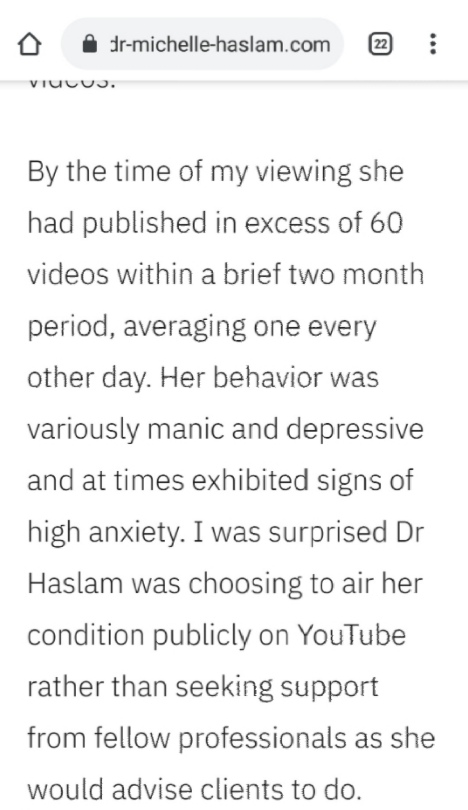
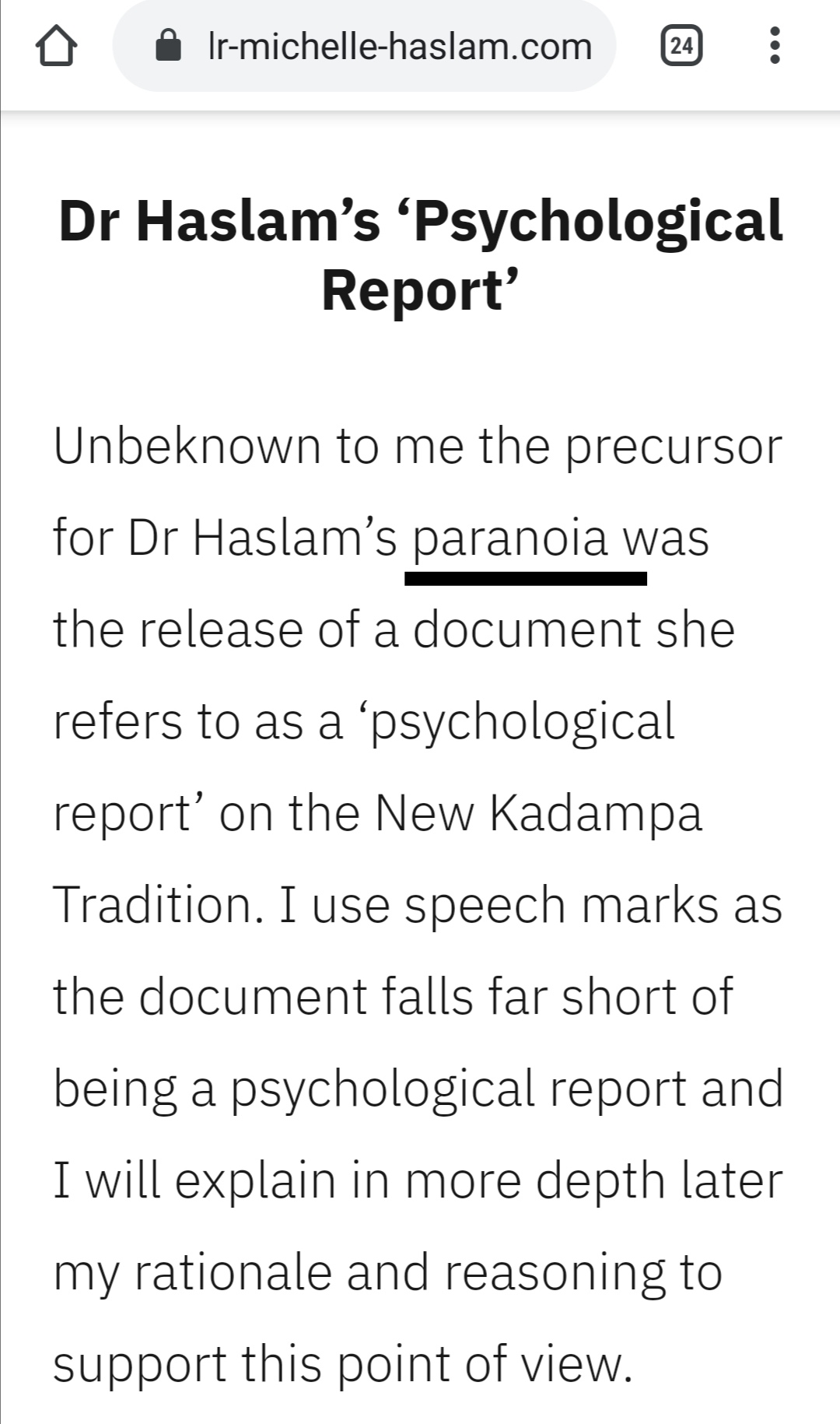
He then (just in time for summer festival) wrote an ENTIRE WEBSITE solely dedicated to character assassination: www.dr-michelle-haslam.com. ‘Dr Robert Harrison’ who claims he is an experimental psychologist (whilst also suggesting he is a clinical psychologist by trying to diagnose me) claims that I was fired for gross misconduct. This is a lie. He uses DARVO (Deny, Attack, Reverse Victim and Offender) to suggest he was caused significant distress by me. 

He also claims he does not have the time or inclination to examine my report in full (he only cares about my mental health, right?) yet he has checked out the report in great detail. In order to discredit it. Why would anyone do that if they were not a senior NKT member? He states he knew nothing about it, but I referred to the fact that I was writing it in my videos, which he stated he watched. So there is no way he could not know I was writing a psychological report on the NKT.

He also managed to find out the date of my father’s death and his age. Creepy, right? The team of stalkers behind him, who have been working behind the scenes as soon as they identified me as a threat, have done well. They couldnt work out my age though, because I was 17 when my father died, not 14. He claims all my trauma must be caused by my father’s death and a relationship breakdown to suggest that the trauma caused by my involvement with the NKT must be minimal. 

In regards to the claims that I am mentally unstable, this is clearly a method for discrediting my report (see page on character assassination). Anders (2019b) argues that ‘such a system of slandering, systematically humiliating women and stigmatizing people, even with terms referring to psychiatric diseases, creates distress and fear in the group and for the individual’. If he had genuine empathy like he is suggesting he does, he would not disclose personal information about my mental health online in order to try to undermine my perception of reality (gaslighting) or to humiliate me, if I was already suffering. 

People in power and their established entourage have the opportunity to use social isolation by spreading rumors about someone, employing public slander or ordering others to do so. And such slander campaigns are not limited to group borders, but may be extended to members’ social background, key relationships or professional relationships‘. (Anders, 2019b) 

Trauma of any kind does not negate my view. Claiming people who write testimonies are too traumatised to be trusted is a cult classic. He claims that I was not having therapy or taking responsibility for myself. This is a lie (how would he know about my therapy anyway?) 

In regards to his claims of plaigairism. The first version was written quickly as I felt unsafe, like they could attack at any moment and I needed to get it finished. I was warned that they would attack immediately. As a result I think I didn’t adequately check I had reworded all the chunks of text I had in my notes. This has now been rectified. The use of plaigairism software indicates that ‘Dr Robert Harrison’ is a member of the NKT with an interest in attempting to ruin my reputation.

Oh NKT you just continue to make this worse. Not only is this sociopathic, it’s actually stupid. It would have been a lot more intelligent to just issue a fake apology to anyone who ‘feels’ they have been harmed. Or at least to use your real name. But they can’t, because they know that then I could sue them for defamation.

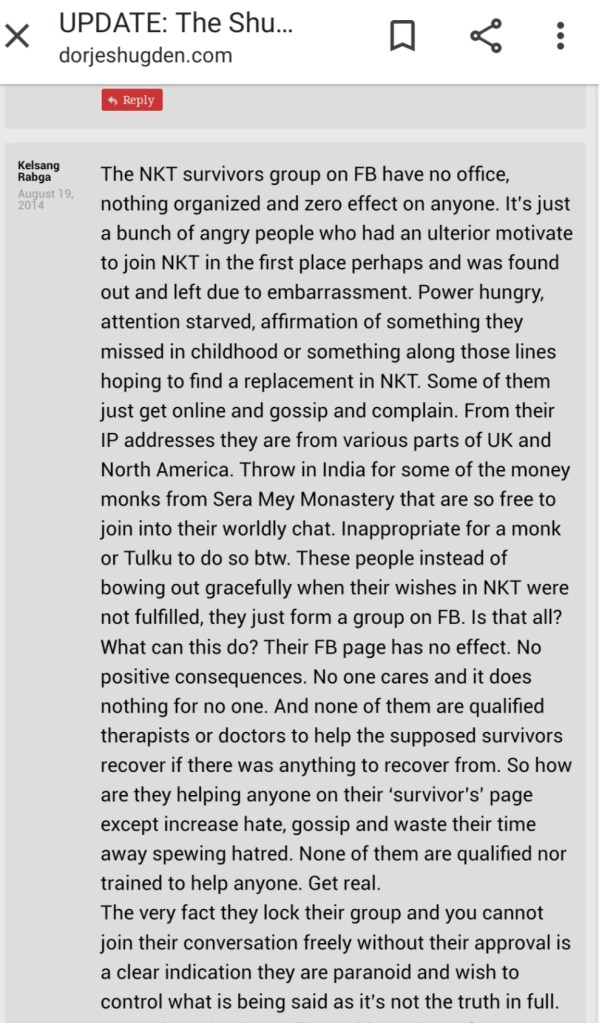
The below screenshot shows what teachers used to claim before I came along to discredit ex-members. I believe this is why they are threatened by me:

In order to escape accountability for his crimes, the perpetrator does everything in his power to promote forgetting. Secrecy and silence are the perpetrator´s first line in defense. If secrecy fails, the perpetrator attacks the credibility of his victim. If he cannot silence her absolutely, he tries to make sure that no one listens. To this end, he marshals an impressive array of arguments, from the most blatant denial to the most sophisticated and elegant rationalization. After every atrocity one can expect to hear the same predictable apologies: it never happened; the victim lies; the victim exaggerates; the victim brought it upon herself; and in any case it is time to forget the past and move on. The more powerful the perpetrator, the greater is his prerogative to name and define reality, and the more completely his arguments prevail (Herman, 2015).

For a further analysis please visit nktworld. I agree with the analysis given on nktworld, and would add that a real Dr of Psychology with concern for my mental state would have no interest in my document on the NKT whatsoever, and would not record everything I say in order to exaggerate and twist it. For a thoughtful article on the abuse I have received by ex-NKT Medium writer Geoffrey Bonn at ‘Leaving the sangha’ please see here.

Update 03.08.19. Today I feel very sad about how the NKT members are being deceived by this narrative created by senior NKT via the fake persona ‘Dr Robert Harrison’. In the first few days of finding it I saw it mainly as an attack on my reputation. But now, I am more aware that really their main priority is to keep people on the inside from the truth. And that is really heartbreaking. They are being deceived on so many levels. The NKT claim they don’t keep people captive, but what is this if not captivity amongst a bunch of fake personas and lies?

References

Anders. A. I. M. (2019a). Psychological impact of power abuse in Buddhist groups and essential aspects in psychotherapeutic interventions for the affected individualsSFU Research Bulletin, 7/1, S. 32-50 DOI: 10.15135/2019.7.1.32-50.

Herman, J. L. (2015). Trauma and Recovery. The Aftermath of Violence—From Domestic Abuse to Political Terror. New York: Basic Books, Member of Perseus Books Group.

Michelle’s testimony

‘Finding my way out of the empty black hole of spiritual narcissism’

July 2019

Having just returned from the International Cultic Studies Association (ICSA) conference, the timing feels right to write my final written testimony. Some of you may have already seen bits of my story, on my YouTube channel ‘Thriving after leaving The New Kadampa Tradition’ in Spring 2019. This is a condensed version of the whole thing. I will speak less about my own vulnerabilities, due to limitations I feel are placed on me by my profession.


I moved in to Nagarjuna Kadampa Meditation Centre in Northamptonshire in November 2016. I was in a more vulnerable state than usual, had lived in an intentional community before, and thought it would be a peaceful supportive environment (that’s what their adverts suggest). To those who have been in the NKT for years, the centres are more obviously slave houses. But this is not obvious to the general public, who they draw in to help pay the bills and then slowly dump more and more responsibilities on through flattery and guilt. Sadly I did not do any research about the organisation, and did not know much about the way cults operate. I had a positive view of Buddhism, as most Westerners do, and knew nothing of the institutional spiritual and psychological abuse. It never would have even occurred to me that I was paying rent to a dangerous organisation with a history of financial abuse and exploitation. I thought that community living was helping the environment and that we were also helping ourselves and others through practicing meditation, which I thought had many benefits through the mindfulness movement. I thought those who only read Kelsang Gyatso’s books were extreme, but they didn’t really bother me. I continued to study a broad range of topics including the neuroscience behind both meditation and trauma. I went on retreats elsewhere, with a group of young Buddhists from the Triratna movement, whom I was fond of. I felt like an unfaithful spiritual slut who had to keep her cheating a secret. And still, the extreme nature of the NKT didn’t set off as many alarm bells as it should have.

I never believed in enlightenment and yet I still thought the sentiment behind a lot of the teachings was beautiful. On my working visit I remember the admin director gave me a mantra to recite whilst doing a tedious ironing job when I got a bit frustrated. At the time, I thought this was kind, but now I see this as the first act of spiritual abuse. It was the first sign that emotions weren’t allowed here, and that people would repeatedly give me orders on how to think and feel when it was not requested. There were many controlling people just lurking around, waiting for you to struggle so that they could act superior and give you advice on how to overcome any healthy human feelings. There were mild, quiet, introverted people around too of course. Those were the ones too busy invalidating their own feelings in their head and creating some kind of ‘pureland’ to bother with you.

I had never been religious and I didn’t know what was happening, but suddenly I was driving through the misty countryside singing the prayers even though I didn’t know what half of it meant. I knew it was about being kind and grateful, and helping others, and that was beautiful to me. What I didn’t know was that I was hypnotising myself with the words despite my poor understanding. Lack of gratitude or being kind had never been my problem, being a good girl and a good student was my problem, one that would slowly destroy my health during my time that I lived there. Somehow, I did start to develop admiration and respect for the teachers even though I didn’t agree with everything they said. I don’t know when it started happening, but I did start to value their perspectives, apart from the bits on feeding hungry ghosts and their bizarre ‘truths’ on where the mind was located and how it apparently contained sperm. I thought I was becoming wiser by aiming to destroy my ‘self-cherishing mind’, but I was actually just reinforcing my pre-existing tendencies of self-neglect and abandonment. Hear something often enough and you will start believing it. Especially when it’s written on the walls. I am clear now that there is a ‘brainwashing’ element, because I was definitely under the influence, especially after a summer festival focusing intensely on my wish to benefit all living beings. It is clear now that I had developed a serious martyr/messiah complex. I became a shell of a person, with little passion and no idea what she needed or wanted. But because of the teachings I believed what I was doing was somehow skillful and impressive. Despite the fact that I would never advise anyone else to do that or be impressed by this. 

It’s funny how you all believe you are supporting each other in developing spiritually. Actually, you are just codependents using and triggering each other, but talking as if your motivation is pure and it’s more skillful than average. You all think you’re on some kind of path, but you’re actually just in a stage of arrested development, maybe even regressing. You’re not learning how to function in the ordinary world at all, and you are learning to invalidate your own and others emotions, a ‘skill’ which will severely damage your interpersonal functioning. But spiritual bypassing and dissociation feels good in the short term, so you might feel like you are getting somewhere, learning to be pathologically happy or numb all the time. Despite not believing in enlightenment, somehow I did come to believe that I was on some kind of incremental path. I hate to admit it, but I suppose I became more of a spiritual narcissist too.

Unfortunately I ended up dating someone who used the teachings to psychologically and emotionally abuse me. Due to the belief that abuse is simply a misconception created by the mind, womanisers learn they can take advantage of multiple vulnerable women and gaslight them even more than they normally would and get away with it. The male residents and teachers all had sex with vulnerable volunteers at Nagarjuna KMC. These volunteers are far from family and friends, and looking for answers to life’s big questions. I don’t think teachers should be allowed to have sex with anyone who attends teachings, but especially their own teachings. This is an abuse of power and awe.

The first time I disclosed the psychological abuse to the admin director she told me ‘nothing matters, that’s what Bridget (the National Spiritual Director) says’. After all other forms of victim blaming have failed people resorted to nihilism to invalidate your experience, your needs and at times your very existence. When I raised my concerns to the ‘National Spiritual Director’ I was minimised and dismissed using the teachings. She told me that ‘enduring suffering is your practice’ and stated that if I wanted to teach dharma, I should endure it (I did not want to teach). It took me several months to understand and accept that she attempted to make me feel spiritually inadequate and manipulate me into staying, and to teach. I imagine she did this because I am young and a mental health professional, and they want to attract more young intellectual people. I didn’t know then about the history of alleged sexual abuse by senior teachers and monks in the NKT that had been enabled, whitewashed, and victims gaslighted. (To hear more details about that, you can listen to this).

Two well meaning but indoctrinated friends told me that I had an impure mind and that’s why I was perceiving impure behaviour, and told me to meditate on being a plank of wood in order to stay in the situation and dissociate from my emotions. One friend who did support me by advising me to leave in order to protect myself from further suffering, told me they would only be there for me again when I felt no anger. A few people admitted that they knew I had suffered abuse, and that narcissists do exist, and pose a risk to vulnerable people in the centres, but they didn’t know what to do with this because it contradicts the teachings which they thought they should be following. The admin director said I should come back to volunteer immediately because I was ‘part of the family’. I believe she felt no warmth towards me at all, however she used the metaphor of family because she wanted a volunteer.

At first I still believed that some people just twist the teachings. I hadn’t yet understood that they were gaslighting by nature. Even if others aren’t gaslighting you, you are doing it to yourself in your own head. I saw that most people had trauma and mild learning disabilities, and I knew they were vulnerable. But hearing all the time that suffering brings people to dharma makes it sound as if the dharma will cure them of it. Whilst I thought this was unlikely, I decided that whatever they wanted to do, if they believe it helps them, that’s great. I felt like something was wrong most of the time, but my stomach became so confused due to the mixed messages and conflict with my own views, in the end I think I lost touch with my intuition. It took me a long time to trust my own perception that it is actually causing them and their bodies more harm. I only really accepted this about six months after moving out. Believing it benefits you is due to the indoctrination and the short term benefits of spiritual bypassing in avoiding emotional pain. Actually, it’s just modern slavery and psychological abuse. Those who met or received teachings from Kelsang Gyatso however are more vulnerable to the experience of awe creating blind spots than I was. I always found his photos a bit creepy. I found it very painful to accept all this and still do find it hard to imagine everyone still there, continuing with that passive aggressive path. I am embarrassed that I even stepped in that building without asking to see their safeguarding policy and I would rather die than teach their abuse enabling warped version of the dharma.

The coldness of most of the people I had been living with really struck me when I left and the general public seemed so warm, genuine and kind. It became very clear that I had been spending time with sadists and masochists. Many people spoke to me and treated me brutally under the name of ‘wisdom and compassion’ at Nagarjuna KMC. Maybe they really thought they were helping me grow by causing me more suffering, but I think they are just sadists who found a place where they are accepted with no consequences for their actions. They too had become ‘brainwashed’ into thinking that their cold words and actions were somehow an expression of kindness and their wisdom, instead of a sign of lack of empathy. 

After six months living in an ‘ordinary’ house, I ‘cult-hopped’ to Triratna, and have a lot of lovely warm memories there. They don’t introduce emptiness teachings to beginners and focus much more on cultivating ‘metta’ and spiritual friendship. They also don’t seem to believe that we should be happy all the time, so there is less spiritual bypassing. But in the end, I found that people from Triratna still occasionally spoke as if they were on a superior path to the general public, and I didn’t want to hang around with spiritual narcissists anymore, so I did another runner. When I read the sexual abuse testimonies (the originals, not the whitewashed perspectives on them) of ‘disciples’ of Sangharakshita I felt sick to the bottom of my stomach. How had I gotten drawn in to a world where this was acceptable in the name of ‘teaching’ others about spiritual development? Gurus and spiritual guides are just narcissists who are elevated to a God like position. I had never even wanted a Guru, I just wanted a ‘sangha’. But without the Guru, there is no sangha.

After reading the testimonies of ex-NKT who had been treated so disturbingly, far worse than myself, I was tortured. The knowledge that most people’s stories are too dark for them to tell disturbed me even more. I dreamt of NKT babies being born and indoctrinated into believing they should only think ‘virtuous’ thoughts. I dreamt of pervy ‘dharma’ teachers groping vulnerable working visitors and lecturing them on how they should be grateful for suffering. I dreamt of people giving up their identities, honestly believing they will achieve enlightenment, and being exploited into ill health. When I saw the online character assassination of ex-members I nearly threw up. I felt like the NKT’s darkness was inside of me and that I had enabled and colluded with it, and it was eating me alive from the inside. It had only ever been about expansion and control, never compassion. We had all been duped. I tossed and turned at night, I had urges to bang my head against walls. Nothing was helping. I still wondered if the whole thing had all been in my head. I wanted to purge it and confess my part. I know that speaking out on YouTube was bold and provocative, but I couldn’t hold it in anymore. It worries me that none of my colleagues questioned what had been happening to me despite my deteriorating health. I think people are wary of questioning your involvement in case it comes across as discrimination. I worry that my partial indoctrination may have affected my natural empathy levels and authenticity. I worry that anyone who saw me there might think that I condone their view of mental health. Which is why I felt I had to make my truth very clear.

I know that my name and reputation may be forever linked to the NKT now I have spoken out. It is likely that some of them will continue to try to destroy my reputation and career in any way they can. Maybe in a few years I might regret speaking up, but right now I don’t. I spoke my truth, I expressed my previously repressed feelings, and it was heard. Now, I feel like a whole person again. One who can let go because I did the necessary processing and sought appropriate support, not because they ordered me to, by passively aggressively suggesting I am spiritually inadequate or by threatening me with rebirth in a hell realm. Seeing their attacks on me in writing confirmed how sick the teachings and organisation are when combined with peoples’ personalities, and disturbed me all over again. The knowledge that people who speak up will continue to be psychologically abused in this way under the name of Buddhism broke my heart again. If I had to describe my whole experience, it would be as a series of heartbreaks, traumas and humiliations. But not the kind that take you back to kadam dharma. The kind that make you face your darkest wounds and defences, and go crawling back to your therapist with your tail between your legs.

In a talk on ‘Why can’t we eliminate cults?’ at the ICSA conference it became clear that we never will, because of our deep seated need for a sense of belonging and meaning. There is certainly a scary void after ending all my friendships from both the NKT and Triratna. But I am ready to build my own sense of community without a strange dysfunctional, extra wounded, codependent and narcissistic ‘family’ judging me for my every emotion or ‘worldly’ action. I have accepted that I need to re-build a tribe one by one, the hard way. Now, I only spend time with people who understand emotions and who can handle mine. I honour and respect all of my feelings, including my fierce, righteous anger. This anger finally broke through nine months after moving out, and it was a powerful force.

Feeling forced to prematurely forgive without acknowledging any of your own pain, can make you even more resistant to forgiving for a while. So instead I focus on forgiving myself, for being naive and idealistic, for not doing any research and downplaying the red flags. My fierce urge to rescue everyone has faded somewhat. A year out, I think I am well on the way to healing the martyr complex. I know I can’t save everyone, not from their trauma, not from narcissists and sadly not from the NKT. There’s no closure from an experience like this, especially if you can’t talk to anyone you knew. Cult relationships are strange and intense. You just have to leave them all behind and build a new life, and hope that one day you won’t dream about them anymore.

Update October 2019:

Following finding the sick defamation website written in my name by senior NKT using fake identities, I had an unsettling summer. I knew the NKT attacked critics but seeing the extent they went to in order to stalk and gather evidence against me shook me to the core. You don’t know how it feels until it happens to you despite seeing evidence of how they have treated those before you. I can’t believe that those who knew me continue to stay in light of this. It has shown me just how powerful the cultic environment and deception is in keeping people trapped. I don’t feel very safe in a world that enables cultic abuse. My health and energy levels are poor, and I have to accept that it may take me a few years to recover. Narcissistic abuse is body and soul destroying. I’m lucky I got away, and can still salvage my career, and yet I sleep fitfully.

Betraying Narcissus a poem (plus trolling)

Update January 2020:

My health has improved dramatically with each week that passes since the defamation. I now feel supported, understood and valued by people in the ex-cult world. I feel able to communicate my needs and boundaries, and I have made friends who understand and respect them. Several residents of NKT centres have reached out to me to say that they have left for good since viewing the attacks on me. I try not to worry too much about their vulnerability after leaving, and let them find their own freedom.

Reflecting on the experience of speaking up and sharing my New Kadampa Tradition story on YouTube

Some of you might have seen my videos on the channel ‘Thriving after leaving the New Kadampa Tradition’. (So many in fact, that at the International Cultic Studies Association conference people are greeting me with the phrase ‘Hi Survivors and anyone else who might be watching this’). Some of you also might have seen that the videos are no longer available to view.

It has been an intense, emotional, profound, authentic and deeply healing few months. As well as the most frightening and abusive of my life.

The guilt that I felt, not speaking up about my view, came from a sense of responsibility as a clinical psychologist to share my concerns about exploitation and psychological abuse. In the end, I couldn’t cope with my own silence any longer.

Sadly, the British Psychological Society social media guidelines state that a Psychologist should not use social media for whistleblowing. So, I felt I had to take them down. I then found that I felt significantly less exposed and safer without them available for all to see. Feeling safe is one of the most important conditions for recovery from trauma. The whistleblowing process alone itself is a trauma, and so I must make self-care my priority now. The report says everything I want to say for now, albeit in a less engaging medium.

I don’t regret what I did. I know I triggered a lot of people to feel painful emotions in speaking my truth. I agree with a good friend of mine when she said ‘the world needs more authenticity that includes pain’. Having the survivors of the NKT and similar groups validate my experience, my emotions, and share their own experiences, was incredibly powerful. Thank you all so much. It also allowed me to feel confident enough in my perception and intuition to write the psychological report. I never could have done that without everyone’s support. Thank you also to the academics, who I am now meeting at the ICSA conference. It has been so grounding, warm and validating (my derealisation has now completely gone).

Myself and other professional members of ICSA are discussing potential collaborations using video, to focus more generally on the concepts covered in my report in future. So after my (long) holiday, these should be uploaded on the NKT survivors channel. So see you in the winter months (well I might not see you, but you might see me).

Thank you for reading 

Michelle